How Dent Repair Professionals Handle Creases and Sharp Body Damage
Understanding Creases and Sharp Body Damage: What Makes These Dents More Complex
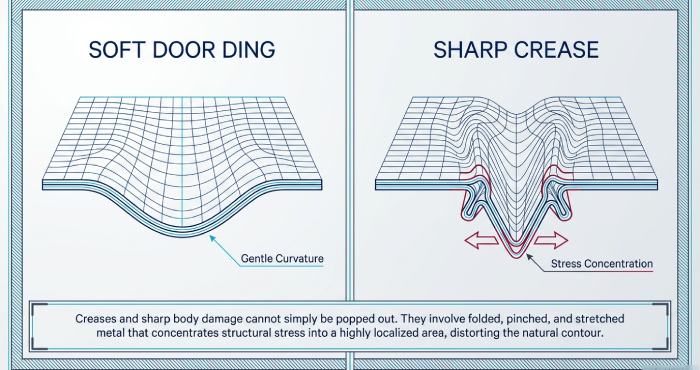
Creases and sharp body damage are among the most challenging forms of dent and ding repair because the metal is not simply pushed inward—it is often folded, pinched, stretched, or stressed along a narrow impact line. Unlike a soft door ding, a sharp crease concentrates force into a small area of the car body, which can distort the panel’s natural contour and create tension in the surrounding metal.
In professional dent repair, the first concern is whether the factory paint is still intact. If the paint has not cracked, chipped, or separated from the panel, paintless dent repair may be possible. Modern paintless dent repair is a highly refined dent repair method that allows expert technicians to restore many creases without sanding, fillers, or repainting. This non-intrusive repair approach is often preferred because it preserves the original finish and supports resale value.
However, not every crease qualifies for PDR. If the metal is severely stretched or the impact created a sharp crown, split paint, or torn edge, auto body repair may be required. A dent repair specialist must understand metal memory, panel access, pressure control, and removal technique to decide whether PDR, conventional auto body repair, or a hybrid damage repair plan is best.
Professional Assessment: Inspecting Paint, Metal Stretching, Depth, and Dent Location
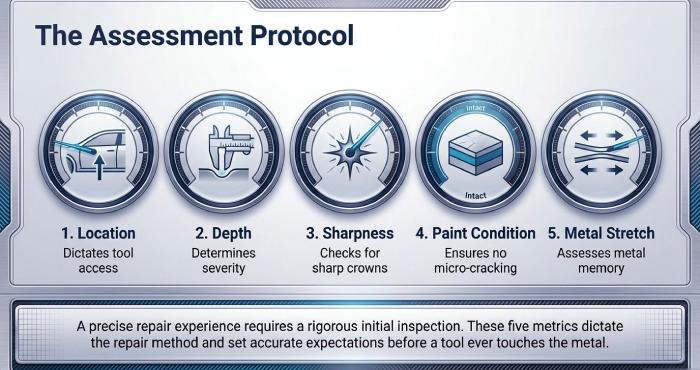
A proper repair experience begins with a detailed inspection. Expert technicians examine the dent location, the depth of the crease, the sharpness of the impact, the condition of the paint, and how far the metal has stretched. This assessment determines the right dent repair method and helps set accurate expectations for dent removal.
Lighting is essential. Technicians use reflection boards, LED line lights, and sometimes a dent image from multiple angles to read distortions across the panel. A crease that looks minor under normal light may reveal complex waves under professional inspection. Before and after documentation is often used to show customers the difference between the original damage and the finished repair.
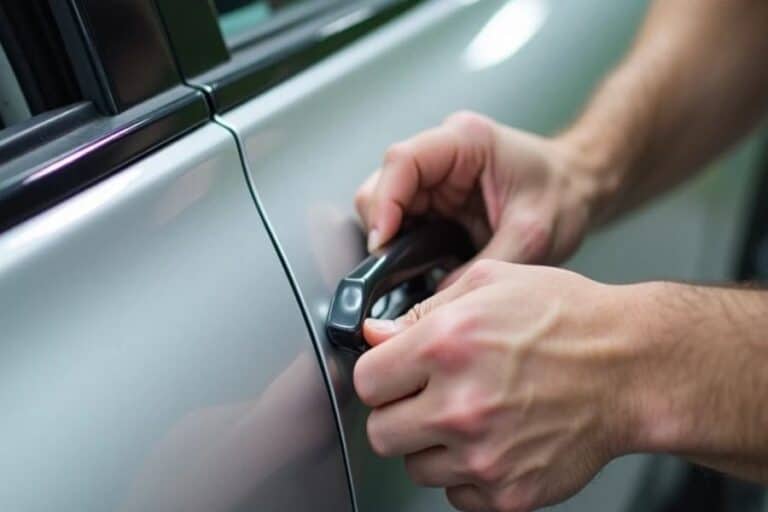
During a professional dent repair evaluation, technicians also consider access. A crease on a door may be reachable through window openings or interior trim removal, while a sharp dent on a quarter panel, roof rail, hood brace, or aluminum panel can be more difficult. Dent location affects repair cost, the number of repair tools required, and whether mobile dent repair is practical.
Mobile dent repair is especially useful when the damage can be repaired on-site. A mobile service can provide automobile dent repair at a home, office, dealership, or fleet location within the provider’s service area. Mobile paintless dent repair is also a strong body shop alternative when the paint is intact and the panel can be accessed safely. For customers seeking fast dent repair or cost-efficient dent repair, mobile dent repair often delivers efficient dent removal without the downtime of traditional vehicle body repair.
Still, honest assessment matters. A trusted repair professional will explain when car dent removal can be handled with PDR and when conventional auto body repair is necessary. This transparency helps customers compare repair needs, repair cost, expected finish quality, and timelines before approving the repair service or requesting a car repair quote.
Tools and Techniques Used in Professional Dent Repair, Including Paintless Dent Repair
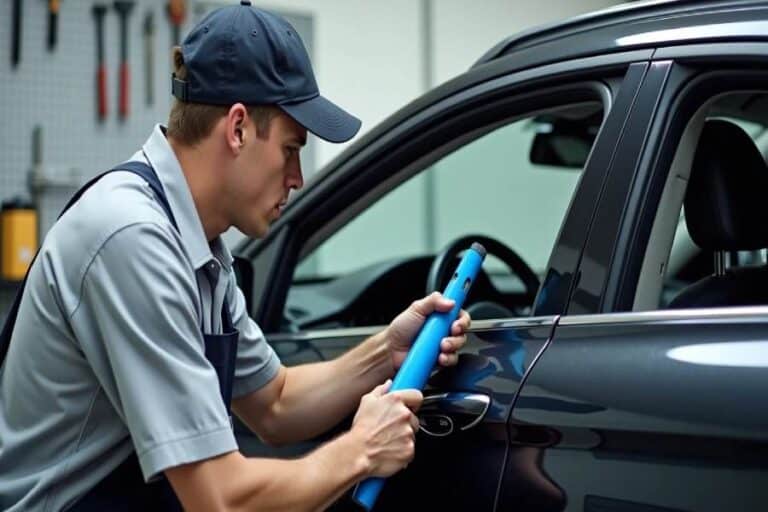
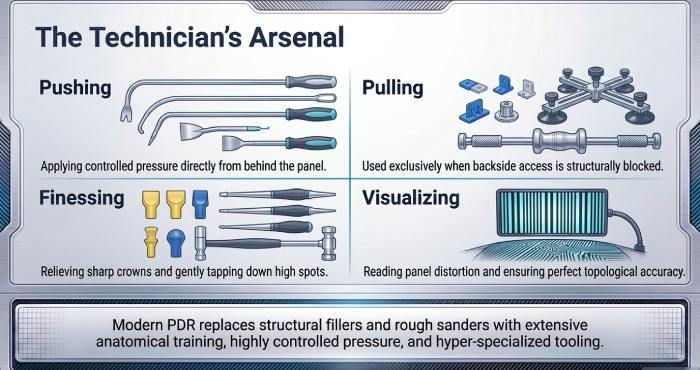
Professional dent repair relies on specialized tools, controlled pressure, and extensive training. The most common PDR tools include metal rods, whale tails, soft tips, knockdowns, blending hammers, glue tabs, pulling bridges, slide hammers, and precision lights. The goal is not simply to push the dent out; it is to move the metal gradually back toward its original state restoration without overcorrecting or damaging the paint.
For sharper creases, expert technicians use a slow and deliberate dent removal strategy. The pressure must be applied from behind the panel in tiny increments, often starting at the outer edges of the damage and working toward the deepest point. High spots are tapped down, crowns are relieved, and the reflection is constantly checked. This makes PDR a dent repair method that requires patience, expertise, and a refined sense of panel behavior.
Paintless Dent Repair for Creases, Sharp Dings, and Complex Panel Distortion
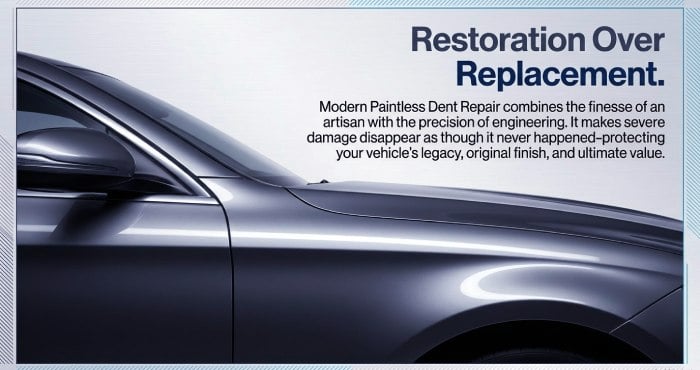
Paintless dent repair is one of the most valuable techniques in modern automotive repair because it keeps the factory coating intact. PDR is widely used for hail damage, door dings, minor collision impressions, and certain sharp creases. In the hands of expert technicians, paintless dent repair can produce a flawless repair that appears as though the damage never happened.
This dent repair method works best when the paint remains flexible and unbroken. PDR is also ideal when the panel has not been stretched beyond recovery. For car dent removal, PDR is often fast and efficient compared with conventional auto body repair because it avoids filler, primer, basecoat, and clearcoat application.
Professional dent repair teams use PDR for ding repair on doors, fenders, hoods, liftgates, and quarter panels. The approach is particularly useful for lease returns, dealership inventory, and owners who care about resale value. Because no repainting is involved, there is no concern about color mismatch, overspray, or loss of original factory finish.
For many customers, mobile dent repair paired with PDR creates a painless repair experience. A technician arrives with repair tools, evaluates the damage, performs the dent removal, and reviews the dent repair results on-site. A repair testimonial often highlights the convenience of mobile dent repair, especially when compared to leaving a car at a body shop for several days.
Step-by-Step Dent Repair Process
- Cleaning and Inspecting: The technician cleans the panel and uses specialized lighting to identify the dent’s full shape and depth.
- Creating Access: Trim, liners, or panels may be removed to safely reach the dent from behind.
- Massaging the Metal: The technician applies controlled pressure from behind to gradually restore the metal’s original shape.
- Using Glue Pulling: When backside access is limited, glue tabs can be used to carefully pull the dent outward.
- Blending the Panel: The surrounding area is refined to create a smooth, even transition between the repaired and original metal.
- Final Inspection: The technician checks the panel from different angles and lighting to ensure the repair looks natural and the finish remains intact.
Professional dent repair combines precise access, controlled metal reshaping, blending, and final inspection to restore the panel’s appearance while preserving its finish.