Paintless Dent Repair Houston: Understanding Dent Location, Depth, and Repairability
What Paintless Dent Repair Is and Why Houston Drivers Choose It
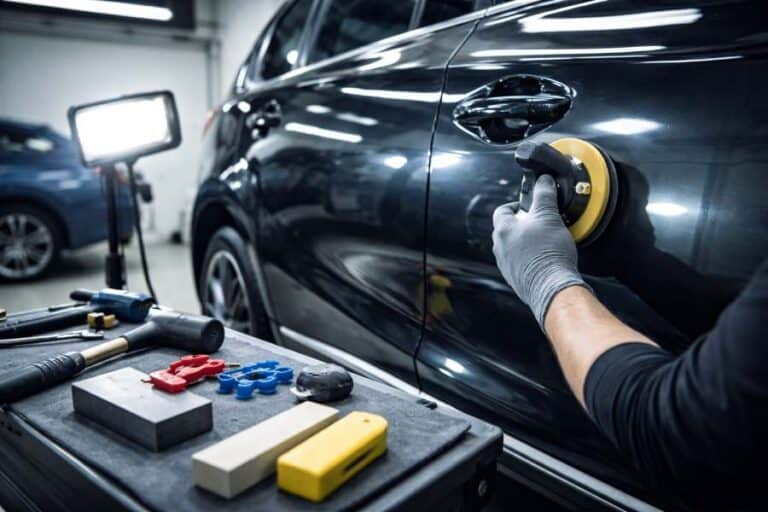
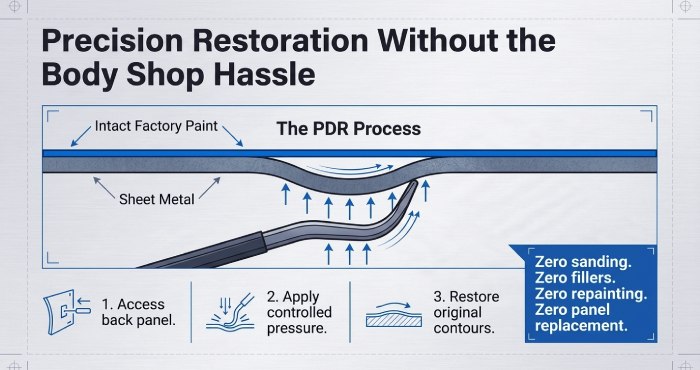
Paintless dent repair is a precision-based auto dent repair process used to restore dents without sanding, repainting, or replacing the damaged panel. Instead of conventional auto body repair methods that rely on paint, fillers, and refinishing, paintless dent removal uses controlled pressure behind or over the panel to return the metal to its original contours while preserving the original finish.
For many vehicle owners in Houston, preserving the original factory finish is an important consideration when choosing a dent repair method. When the paint remains intact, Paintless Dent Repair (PDR) can often restore the damaged panel without sanding, fillers, or repainting. Drivers may compare PDR with traditional auto body and collision repair to determine which option is appropriate for their vehicle and the extent of the damage.
Paintless dent removal is especially useful for minor dents, door dings, hail damage, and certain parking lot impacts. In the Houston area, where Texas storms can create widespread auto hail damage, PDR can be an alternative to conventional body repair when the damage is suitable for paintless repair.
Why PDR fits Houston driving conditions
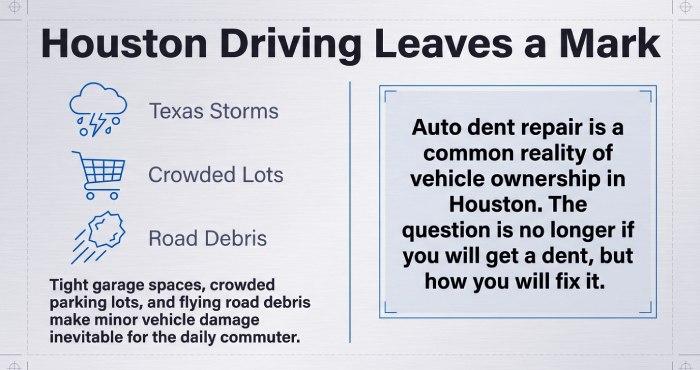
Houston TX drivers deal with crowded parking lots, flying road debris, sudden hailstorms, and tight garage spaces. These conditions make auto dent repair a common part of vehicle ownership. PDR offers a fast turnaround, a lower cost in many cases, and an environmentally friendly process compared with traditional auto body repair.
Paint preservation and long-term value
The main reason PDR is so valuable is that it protects the original finish. A vehicle with intact paint, factory standards, and a documented repair process can better preserve resale value than one that required repainting. This is important for Classic Cars, luxury brands, Trucks, and work vehicles used for Home or Business purposes.
How Dent Location Affects Paintless Dent Repair Success
Dent location is one of the most important factors in paintless dent repair success. Even when the paint is intact, the location of the damage determines whether specialized tools can access the back side of the panel and whether the metal can be worked back smoothly.
A shallow dent on the center of a hood, door, or roof may be an ideal candidate for paintless dent removal. A sharp dent near a panel edge, body line, or reinforcement brace may require more advanced auto dent repair techniques. In some cases, traditional auto body repair may be necessary if access is blocked or if the panel has structural issues.
Flat panels and open access areas
PDR is often most effective on accessible panels with broad, open surfaces. Hoods, doors, roofs, trunk lids, and quarter panels can frequently be repaired with dent removal methods when the paint has not cracked. Skilled repair specialists use lighting, reflection boards, and specialized tools to read the distortion and massage the metal back into place.
This kind of panel repair is common after auto hail damage because hail often leaves multiple shallow dents across horizontal surfaces. When performed correctly, hail damage repair can restore the car’s exterior while maintaining the original finish and avoiding an auto body shop repaint.
Edges, braces, and tight access points
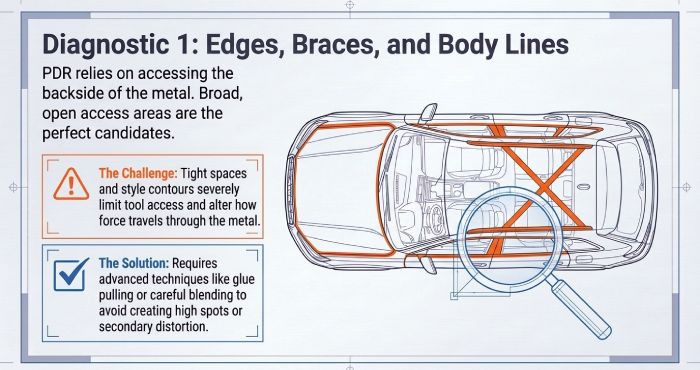
Dents along panel edges, near door seams, or close to internal braces are more complex. These areas may limit tool access and require glue pulling, blending, or advanced PDR techniques. Professional technicians must understand how force travels through the metal to avoid creating high spots or secondary distortion.
Body lines and style contours
Sharp body lines on modern vehicles require precise PDR to restore the panel’s original contour to factory standards.
Understanding Dent Depth, Size, and Metal Stretching
Dent depth, size, shape, and paint condition all affect PDR repairability. Technicians assess the dent and surrounding tension to determine whether the metal can be restored to its original shape or if conventional body repair is more suitable.
Reading depth and impact sharpness
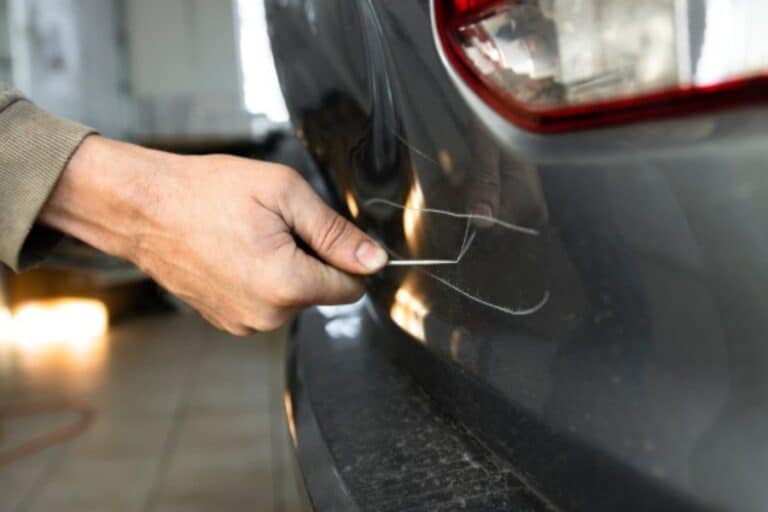
A soft dent from a door bump or hailstone usually responds well to auto dent repair. A sharp impact from a shopping cart corner, falling branch, or pointed object may be more difficult. The sharper the impact, the more likely the paint, primer, or metal structure has been compromised.
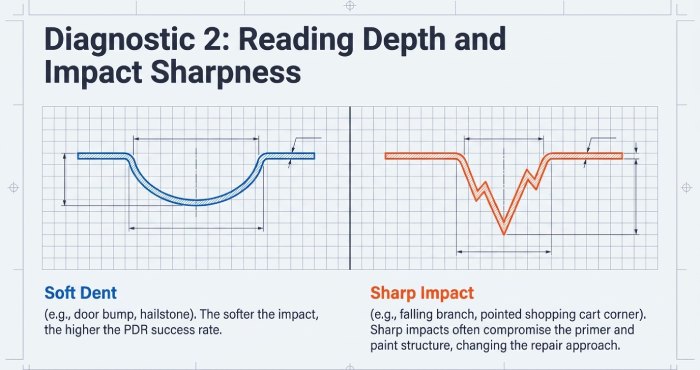
Paintless dent repair is most successful when the paint is intact and the metal can be gradually moved back into its original contours. For this reason, PDR is frequently recommended for cosmetic issues, minor dents, and auto reconditioning where the goal is vehicle restoration without repainting.
Metal stretching and repair limits
When an impact stretches the metal beyond its natural limit, PDR may not fully restore the panel. A reliable repair specialist should explain whether PDR, conventional repair, or a combination will provide the best result.
Common Houston Dent Scenarios: Hail Damage, Door Dings, and Parking Lot Impacts
Hail damage across roofs, hoods, and trunks
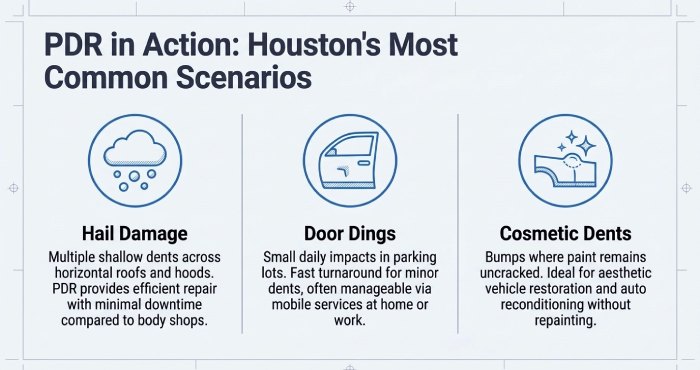
Hail damage repair is a common use of paintless dent repair in Houston, where Texas storms can leave multiple dents across roofs, hoods, deck lids, and fenders. When the paint remains intact, PDR can provide an efficient repair option with less downtime and no unnecessary repainting.
Door dings, parking lot dents, and daily damage
Door ding repair is another major category. Parking lot impacts often leave small dings and dents on doors and quarter panels. These dents may look minor, but they can affect the car’s exterior and overall appearance. With PDR, professional technicians can often complete dent removal quickly, sometimes through mobile services at home or work.
How Technicians Assess Repairability and When Traditional Repair May Be Needed
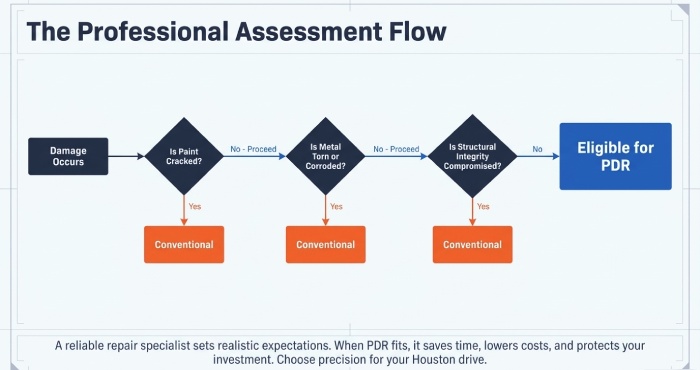
A proper damage assessment checks the lighting, paint, panel structure, metal type, access, and previous repairs. Technicians then determine whether PDR can restore the dent effectively or if conventional repair is more suitable, while clearly setting realistic expectations.
When traditional auto body repair may be required
Traditional repair may be necessary for cracked paint, torn metal, corrosion, severe creases, or structural damage. When the panel and paint remain suitable for PDR, paintless dent repair can be an effective option for hail damage, door dings, and other cosmetic dents. Learn more about Paintless Dent Repair Houston and how it can restore eligible vehicle damage without conventional refinishing.