
When Paintless Dent Repair Pays Off—and When It Doesn’t
Executive takeaway
Paintless dent repair can lower costs and preserve factory paint when the damage suits the technique. Commercial reports describe substantial price advantages for minor dents, but they do not establish a verified average discount. Hail damage and door dings are important applications; mobile delivery adds potential convenience. DIY kits can reduce upfront spending, yet reliable success rates and rework costs remain unknown.
Assess eligibility first, define the expected finish, and compare written estimates for equivalent work. Include actual downtime and transport costs, but avoid assuming resale gains, guaranteed turnaround, or Houston-specific savings.
A lower repair bill starts with the right dent
When does paintless dent repair offer better value than conventional bodywork? The answer starts with the damage—not the advertised discount.
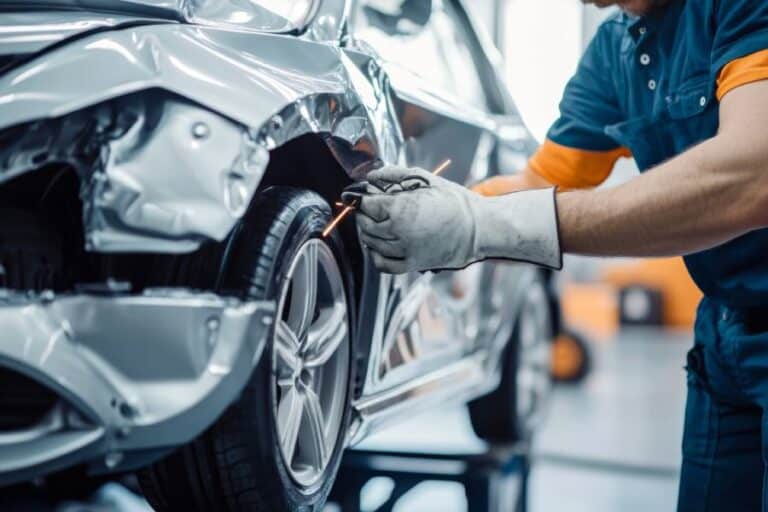
Paintless dent repair, or PDR, reshapes dented metal without body filler or repainting. The supplied account of Bosson Research’s market report describes technicians accessing a panel’s underside and carefully restoring its shape. The aim is to improve appearance while retaining the existing finish.
PDR offers three potential benefits: a lower invoice, preserved factory paint, and shorter downtime. Avoiding filler and refinishing removes work that conventional repairs may require. Those advantages depend on whether metal reshaping alone can deliver the intended result.
Published prices suggest a substantial cost difference for some repairs. The 2025 Dataintelo tools report gives indicative prices of $300–$600 for minor PDR repairs, versus $1,200–$2,500 for conventional bodywork. These ranges provide context, not matched quotes for a particular vehicle.
Intact paint, workable access, and repairable deformation underpin the proposition. If the panel also needs refinishing, a PDR-only price may omit necessary work. Preserving the finish matters only when that finish remains serviceable.
This article evaluates supplied summaries of commercial market research, not independent repair tests. It compares reported prices, market estimates, and descriptions of repair scope. Original report text and underlying repair records were not supplied, limiting verification of methods and outcomes.
The central question is therefore broader than “How much cheaper is PDR?” It is whether PDR can achieve an acceptable finish with meaningful savings in money or time. Technical suitability establishes the options; comparable estimates determine their value.
What PDR can fix—and what needs another approach
PDR suits cosmetic metal damage that can be corrected without rebuilding the finish. The Bosson Research summary describes minor dents, door dings, and hail damage as applications. It does not present PDR as a substitute for structural collision repair.
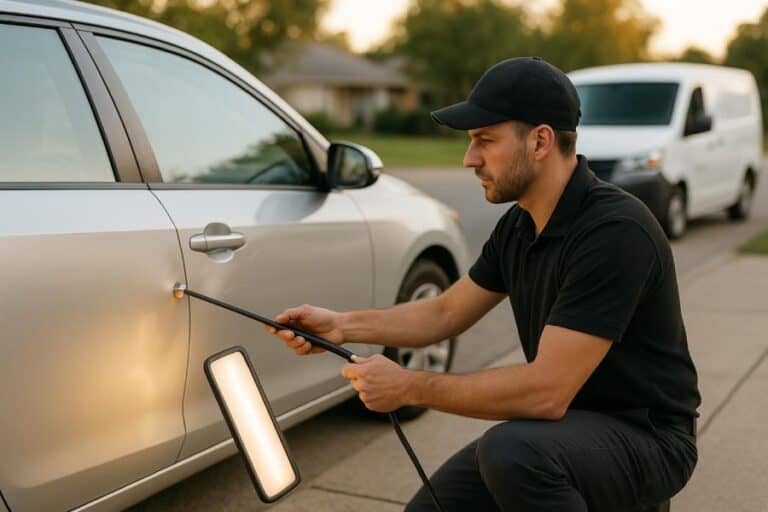
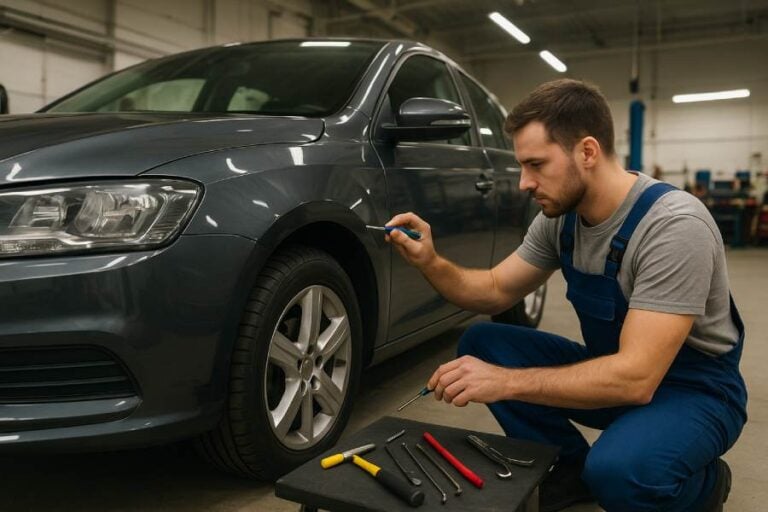
Specialized equipment helps technicians control the metal’s movement. Rods, glue-pull fixtures, and lighting systems feature in the supplied automotive PDR tools overview. Rods work from behind the panel; glue-pull equipment provides an outside approach. Lighting helps technicians assess remaining surface distortion.
A useful assessment separates four questions:
- Paint condition: Cracked, missing, or failed paint requires attention beyond reshaping the metal. A scuff needs inspection rather than an assumption that the finish remains sound.
- Panel material: The supplied definitions concern metal body panels, not plastic bumpers. Identifying metal establishes scope, not repairability.
- Deformation: Shallow dents with intact paint fit the clearest use case. Torn or severely stretched metal falls outside the scope described in the mobile repair analysis. Structural damage also requires more than cosmetic correction.
- Access: Technicians need a workable way to reach and control the damaged area. Having rods or glue-pull equipment does not establish that either approach suits a particular dent.
Hail dents and door dings can combine intact paint with localized deformation. Their cause alone, however, does not establish eligibility. A hail dent with cracked paint presents a different repair problem from one with an undamaged finish.
Creases and panel edges require assessment, not blanket rejection. A sharp crease raises questions about deformation; an edge location raises questions about access. The supplied evidence does not establish either feature as a universal exclusion.
These summaries describe general applications, not dent-by-dent technical standards. The reported 70–85% minor-damage coverage figure is particularly unsuitable for judging individual eligibility. The supplied account combines PDR with other mobile repair technologies and describes the figure inconsistently. It is not a verified PDR success rate.
Before quoting, a technician should explain the achievable finish and whether the existing paint can remain intact. Where conventional bodywork is necessary, that recommendation should follow from the panel’s condition rather than a generic rule.
What the published prices actually tell us
Published prices support a possible PDR cost advantage, but not a verified average discount. The distinction matters because broad ranges can produce misleading percentage comparisons.
The 2025 Dataintelo PDR tools report gives $300–$600 for minor PDR repairs, versus $1,200–$2,500 for conventional bodywork. The supplied summary attributes these figures to insurance industry data involving similar damage profiles. However, it provides no paired repair records or detailed sampling methods.
The 2025 Marketintelo kits report gives a broader professional PDR range: $300–$1,500 per dent, depending on severity and location. This need not contradict Dataintelo’s minor-repair range. The reports describe different scopes, and neither shows how frequently customers pay particular amounts.
The advertised 50–70% savings claim requires separate scrutiny. The Marketintelo mobile repair analysis reports that PDR can cost 50–70% less than traditional bodywork. The supplied evidence does not provide matched estimates or an independently checkable calculation supporting that range.
Arithmetic using Dataintelo’s price bands illustrates the problem:
- Comparing $600 with $1,200 gives a calculated reduction of 50%.
- Comparing $300 with $1,200 gives a calculated reduction of 75%.
- Comparing $300 with $2,500 gives a calculated reduction of 88%.
These are calculations from unmatched endpoints, not observed customer savings. The evidence does not establish that the selected prices cover identical dents, vehicles, locations, or finishes. Choosing different endpoints changes the answer without improving comparability.
A midpoint comparison would not solve this problem. A range’s midpoint is not necessarily the average price paid, and it cannot reveal differences between paired quotes. The published ranges therefore do not independently validate the claimed 50–70% savings.
This does not prove that the savings claim is false. It means the evidence supports a potential price advantage more clearly than a precise average percentage.
For an individual vehicle, compare written estimates covering the same damage and intended result. Establish whether each price includes all identified dents, necessary component removal, materials, and any paintwork. Ask what findings could change the method or amount.
Expected finish is part of that comparison. Partial cosmetic improvement is not equivalent to a more complete restoration, even when both proposals address the same panel. Likewise, a PDR-only estimate cannot substitute for complete repair when damaged paint also needs attention.
A meaningful saving compares viable repairs with equivalent scope and acceptable outcomes. Only then does calculating the price difference help the decision.
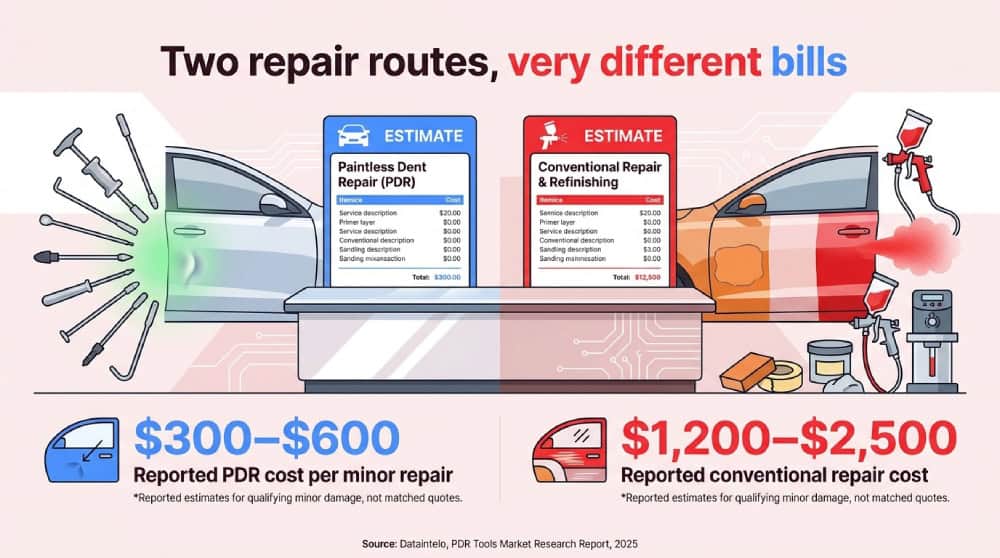
Source: Dataintelo, PDR Tools Market Research Report, 2025
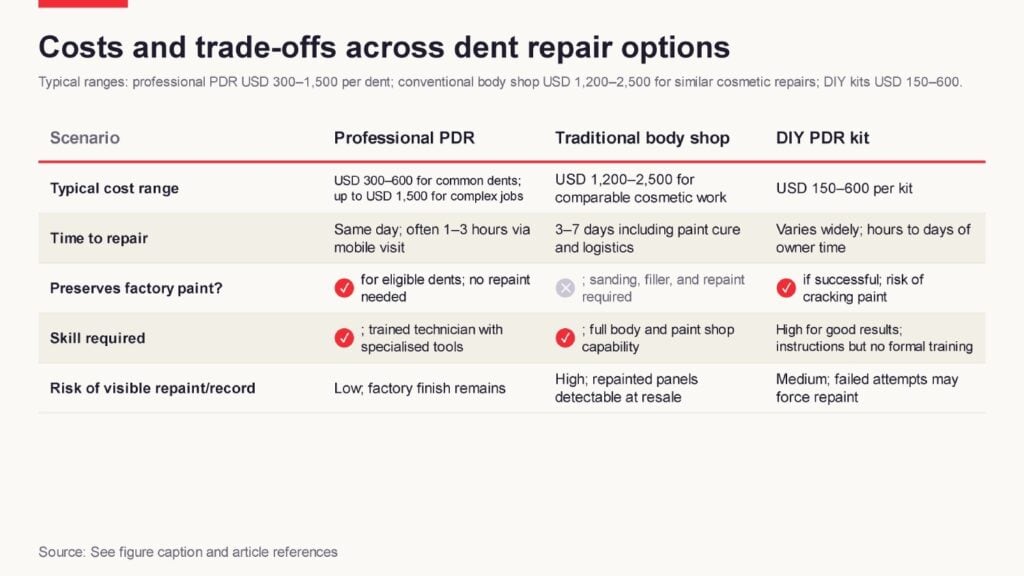
Professional PDR usually sits between DIY kits and full body-shop repair on price, while offering factory paint preservation and professional finishing that DIY kits rarely match. Method: Cost and feature ranges drawn from Dataintelo’s PDR tools analysis and Marketintelo’s PDR kits study, supplemented by qualitative descriptions from mobile PDR service reports.
A growing market with a surprisingly blurry size
Commercial forecasts anticipate growth, but estimates of PDR’s size differ sharply. Three reports place global service revenue between $2.03 billion and $8.9 billion in 2025:
- GII: $2.03 billion in 2025. Its report published in August 2025 forecasts $2.89 billion by 2030 and reports 7.28% compound annual growth.
- HTF Market Intelligence: $4.1 billion in 2025. Its January 2026 report forecasts $6.9 billion by 2033 and reports 7.2% annual growth.
- Deep Market Insights: $8.9 billion in 2025. Its November 2025 analysis forecasts approximately $13.7 billion by 2031 and reports 7.4% annual growth.
Publication dates and reference years serve different purposes. HTF’s 2025 estimate is not a measurement for its 2026 publication year. Values assigned to 2030, 2031, and 2033 are forecasts, not observed revenues.
The largest 2025 estimate is approximately 4.4 times the smallest, calculated as $8.9 billion divided by $2.03 billion. The supplied material cannot reconcile this substantial disagreement. Different market boundaries may contribute, but attributing each discrepancy to specific inclusions would exceed the evidence.
Broader categories demonstrate why definitions matter. Dataintelo’s PDR market report combines services with equipment, including rods, lights, glue-pulling systems, and kits. Its $7.0 billion estimate for 2025 is therefore not directly comparable with a service-only total.
Service, mobile, tool, and kit markets should not be added together. Mobile delivery can already fall within service revenue, while equipment appears within some broader PDR totals. These are potentially overlapping categories, not necessarily separate revenue pools.
The reported service-growth rates cluster near 7% annually, but that apparent agreement needs qualification. Compound annual growth is the constant yearly rate connecting a starting value with an endpoint. Some reported rates do not reproduce the displayed values over the stated intervals. The supplied summaries do not explain whether different base periods, rounding, or other assumptions account for the discrepancies.
Nor does similar forecasting establish independent confirmation. The evidence does not show whether publishers use separate datasets or shared assumptions. Their projections indicate similar expectations, not demonstrated future growth.
The claim that PDR represents 8–10% of automotive repair spending is also unsupported. Dividing the cited $8.9 billion PDR estimate by the $780 billion repair-market total gives approximately 1.1%. The supplied evidence attributes the broader total to Dataintelo’s tools report, but does not establish comparable definitions and reference periods. This calculation rejects the stated arithmetic; it does not validate a replacement market-share estimate.
Market forecasts help describe commercial interest in PDR. They cannot establish workmanship, individual savings, or the availability of a suitable local repair.
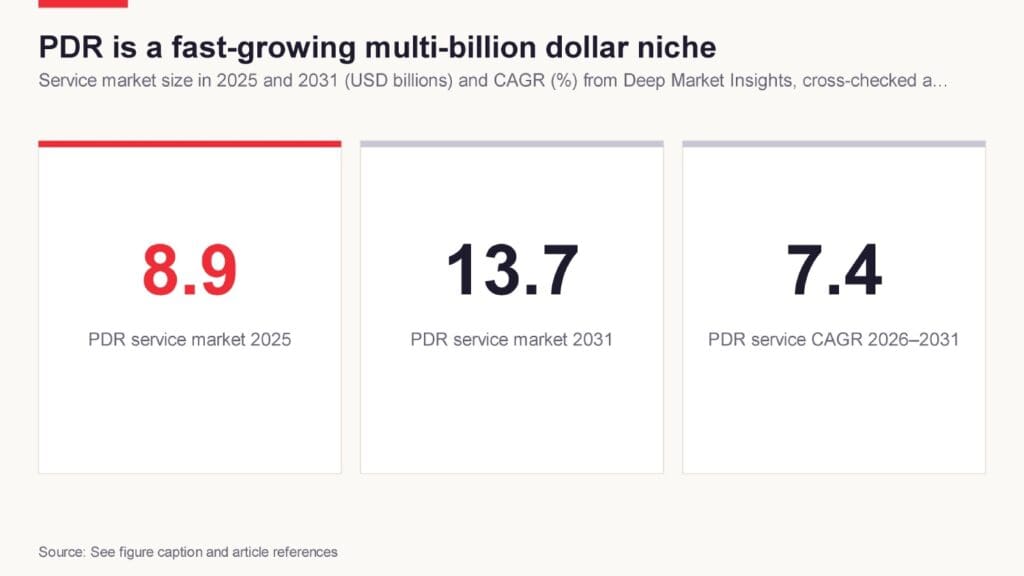
Several independent forecasts show the global PDR service market growing at roughly 7% annually, from mid-single-digit billions of dollars in 2025 toward the low teens by the early 2030s, outpacing the broader automotive repair and maintenance market. Method: Compiled from Deep Market Insights, HTF Market Intelligence, and GII Research estimates of global PDR service revenues and growth rates for 2025–2031.
Why hail sits at the center of PDR
Hail is a major PDR application, according to the supplied commercial evidence. Deep Market Insights’ 2025–2031 forecast assigns hail repair approximately 36% of global PDR service revenue, making it the largest damage segment. The supplied account does not specify the segment estimate’s exact reference year.
The technical fit is straightforward: hail can produce numerous small dents while leaving paint intact. Reshaping those dents may avoid replacing an otherwise serviceable finish. Yet hail describes the cause, not the required repair. Paint damage or unsuitable deformation can still require conventional bodywork.
A large revenue share does not establish repair success. It reveals neither the proportion of hail-damaged vehicles eligible for PDR nor their average savings. Revenue also differs from repair counts, so it cannot directly measure how commonly technicians perform a particular job.
Two further estimates from Deep Market Insights describe other dimensions of demand. Passenger cars represent roughly 53% of total PDR demand, while insurance-linked repair networks hold about 32% of the market. Their exact segment reference years and measurement methods are unavailable in the supplied summary.
These percentages should not be added together. Hail is a damage category, passenger cars are a vehicle category, and insurance-linked networks describe a channel. The network figure does not establish what proportion of hail claims receive PDR.
Organized repair work also requires coordination. Growth Market Reports’ 2025 network-management analysis describes software and coordination platforms serving insurers and large repair groups. This establishes a reported infrastructure category, not evidence of repair quality or available technician capacity.
Demand extends beyond storm-related insurance work. Worldwide Market Reports’ 2026 summary identifies dealerships as its largest end-user industry and links demand to cosmetic preparation for resale. The supplied research also describes fleet and lease-return preparation as applications.
These different rankings are not inherently contradictory: damage types and customer groups measure different things. Their useful contribution is identifying commercial applications, not predicting an individual vehicle’s outcome.
For Houston customers, global segmentation cannot establish post-storm capacity, insurer deployment, or appointment availability. Those questions require current local information alongside inspection of the damaged vehicle.
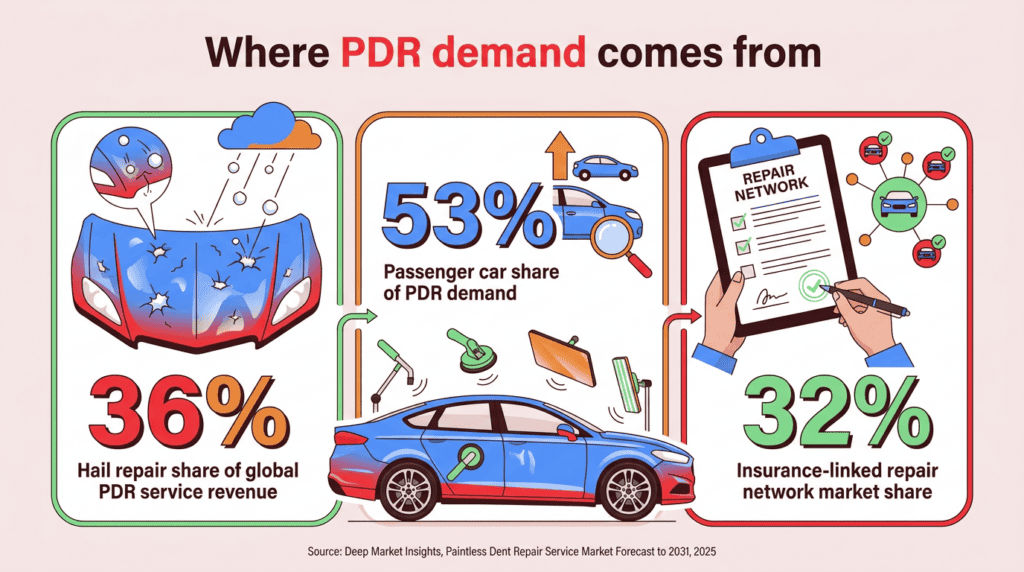
Source: Deep Market Insights, Paintless Dent Repair Service Market Forecast to 2031, 2025
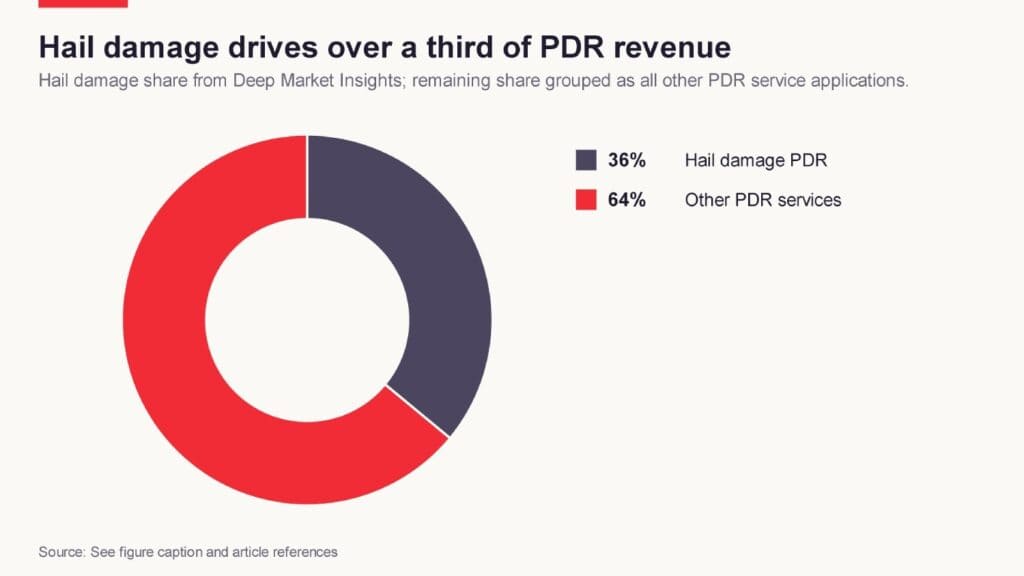
Hail damage repairs account for about 36% of global PDR service revenues, illustrating how much of the industry is built around repetitive, paint-intact dents rather than isolated collision events. Method: Segment share taken from Deep Market Insights’ breakdown of PDR service revenues by application, grouping hail-related work against all other PDR services.
Factory paint and downtime belong in the estimate
Preserving factory paint is a process benefit, not a measured resale premium. PDR avoids filler and repainting when reshaping alone can restore the panel, as described in the Bosson Research summary. It therefore avoids replacing a sound finish merely to correct underlying deformation.
Skipping refinishing removes associated preparation and paint-curing stages. It also avoids the need to match replacement paint on the repaired area. These differences explain potential efficiencies, but they do not mean every eligible dent requires little work.
Owners should separate finish preservation from predictions about future vehicle value. The supplied evidence provides no measured resale premium, corrosion benefit, or environmental saving that can responsibly be assigned a value. Such benefits should not be added to a repair estimate as established returns.
Hours rather than days is a reported possibility, not a turnaround guarantee. Growth Market Reports’ 2025 mobile PDR analysis describes eligible repairs completed within hours rather than the days associated with full refinishing. It does not supply a reliable completion-time distribution for individual jobs.
The relevant measure is the whole period without the vehicle, not simply time spent reshaping metal. Ask providers to distinguish their next appointment, expected repair duration, and handover time. A short repair booked much later may not solve an immediate transport problem.
Compare practical costs alongside the invoice:
- Transport expenses: Use expected rental, rideshare, public transport, or collection costs. Do not assume every repair requires a rental vehicle.
- Lost vehicle use: Identify journeys or assignments needing alternative arrangements. Fleet managers should distinguish reassigned work from work genuinely lost.
- Scheduling inconvenience: Include drop-off, collection, and coordination time. Keep these burdens separate from cash expenses unless there is a defensible valuation.
- Timing uncertainty: Record completion conditions and whether the estimate covers the full period of unavailability.
This approach avoids overstating savings when an owner has another vehicle or a fleet has spare capacity. Count costs likely to occur, rather than treating every unavailable hour as a financial loss.
Mobile delivery changes the service location, not technical eligibility. An at-home or workplace appointment may eliminate a drop-off journey, but cannot make damaged paint repairable through reshaping alone. Confirm both repair suitability and location requirements before relying on that convenience.
DIY kits save labor only if the repair succeeds
A DIY kit’s purchase price is not the cost of a completed repair. Buying tools transfers labor to the owner without establishing whether the result will be acceptable.
The 2025 Marketintelo kits report places high-quality DIY kits at $150–$600, compared with $300–$1,500 per dent for professional PDR. These broad ranges overlap and do not compare identical damage. A kit can cost less upfront, but that difference is not automatically a saving.
The same report states that 43% of kit purchasers prioritize avoiding professional labor costs. The supplied material does not include the survey sample, recruitment process, questions, or methods. This is a reported motivation, not evidence that a representative share of purchasers saved money.
Equipment ownership and repair skill are distinct. The cost of rods, pulling equipment, and lighting does not capture the judgment needed to reshape metal and assess residual distortion. The evidence leaves four important parts of DIY economics unmeasured:
- Acceptable-result rates: How often do beginners achieve a satisfactory finish, and how is satisfaction defined?
- Learning and repair time: How long do owners spend practicing, repairing, and assessing results?
- Paint damage: How often do attempts damage the finish, and what does correction cost?
- Professional rework: How often do owners subsequently hire technicians, and what additional expense follows?
Consider a hypothetical $250 kit against a $400 professional quote. The upfront difference is $150 before accounting for time or corrections. Reusing the kit could spread its purchase cost across several repairs, provided those repairs succeed.
These uncertainties do not establish that most DIY attempts fail. Nor do they prove that professional repair always has the lower expected cost—the average cost across possible outcomes. Calculating that comparison requires outcome probabilities the supplied evidence lacks.
Market growth measures spending, not repair success. Two forecasts describe related equipment categories:
- PDR kits: Marketintelo estimates $1.2 billion in 2025 and forecasts $1.9 billion by 2034.
- Automotive paintless dent removal tools: Research and Markets estimates $1.5 billion in 2025 and forecasts $2.0 billion by 2032.
Different definitions and forecast periods prevent direct comparison. Kits and tools may overlap, while tool purchases can serve professionals as well as consumers. Neither forecast establishes beginners’ results or demonstrates that equipment replaces expertise.
Low-stakes experimentation is therefore a risk-tolerance decision, not a proven financial advantage. Before buying, define an acceptable finish, a limit on learning time, and a budget for possible correction. Someone comfortable retaining an imperfect result faces a different decision from someone requiring near-invisible restoration.
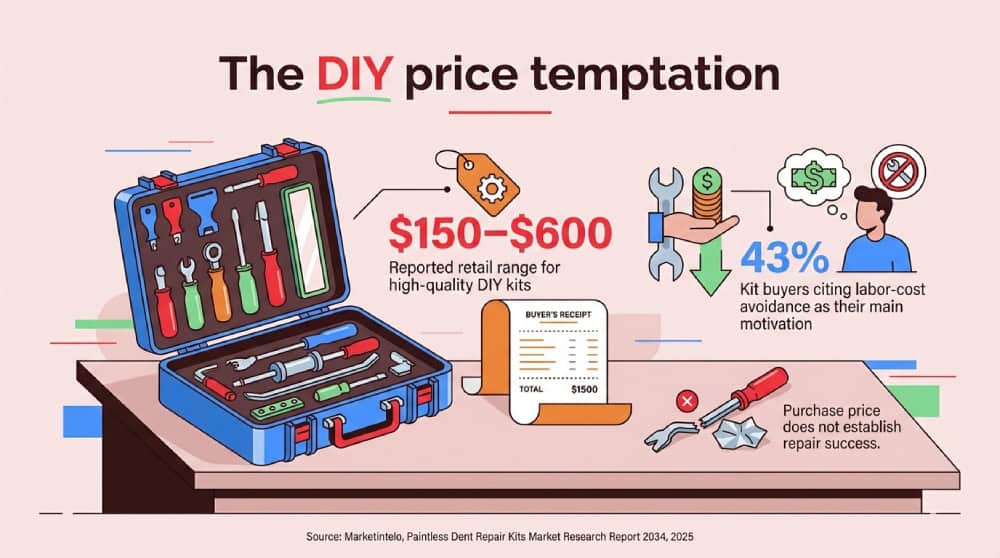
Source: Marketintelo, Paintless Dent Repair Kits Market Research Report 2034, 2025
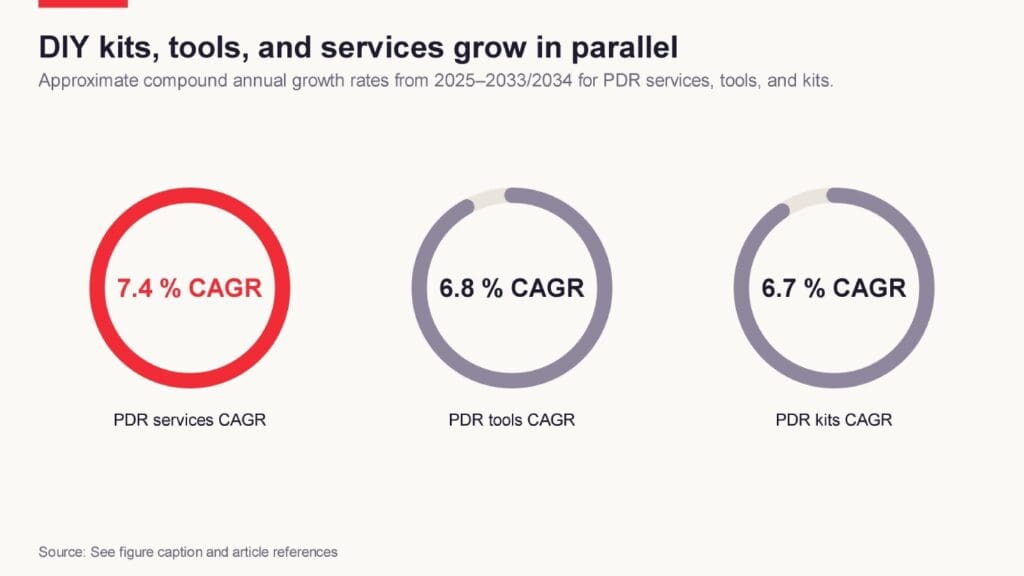
PDR services, tools, and kits all show mid-single- to high-single-digit annual growth rates through the early 2030s, reflecting broad adoption across insurers, technicians, and consumers rather than growth confined to a single product type. Method: CAGRs drawn from Deep Market Insights for services, Dataintelo for tools, and Growth Market Reports for kits, using reported forecast horizons.
Build a repair decision around condition, quotes, and risk
The following checklist translates the evidence into an editorial decision framework. It is not a validated diagnostic tool or a substitute for inspecting the vehicle.
- Establish which repair methods are viable.Have a professional assess paint condition, panel material, deformation, and access. Request a recommendation—PDR, conventional bodywork, or further inspection—and ask what physical findings support it. Dent size alone should not determine the answer.The supplied mobile repair analysis places failed paint and torn or severely stretched metal outside PDR’s usual cosmetic scope. Such findings should prompt discussion of additional or alternative repair work, not assumed PDR savings.
- Compare written estimates for equivalent outcomes.Where both methods are viable, obtain estimates covering the same dents and panels. Ask each provider to describe the expected finish, including any remaining distortion. Published price bands provide background; the vehicle-specific estimates establish the relevant comparison.
- Clarify scope and authorization before work begins.Record what the price includes and what remains uncertain. Useful questions include:
- Which dents and panels will you repair?
- What imperfections might remain?
- Does the price include necessary component removal and refitting?
- What findings could change the method, price, or completion date?
- Will you seek approval before additional work?
- Evaluate DIY against the result you require.Decide whether you would accept visible imperfections and possible professional rework. The Marketintelo kits report supplies prices and buyer motivations, but the available evidence lacks reliable success rates and typical correction costs. A lower equipment price therefore cannot establish a lower total repair cost.
- Plan around actual vehicle availability.Confirm the appointment date, completion estimate, and full period without the vehicle. Include likely transport expenses and essential journeys. Fleet managers can use the same checklist across providers, recording replacement needs and work that cannot be reassigned.
Choose a viable repair with clear scope, an acceptable finish, and manageable uncertainty. The strongest recommendation explains both what PDR can achieve and when another method better meets the need.
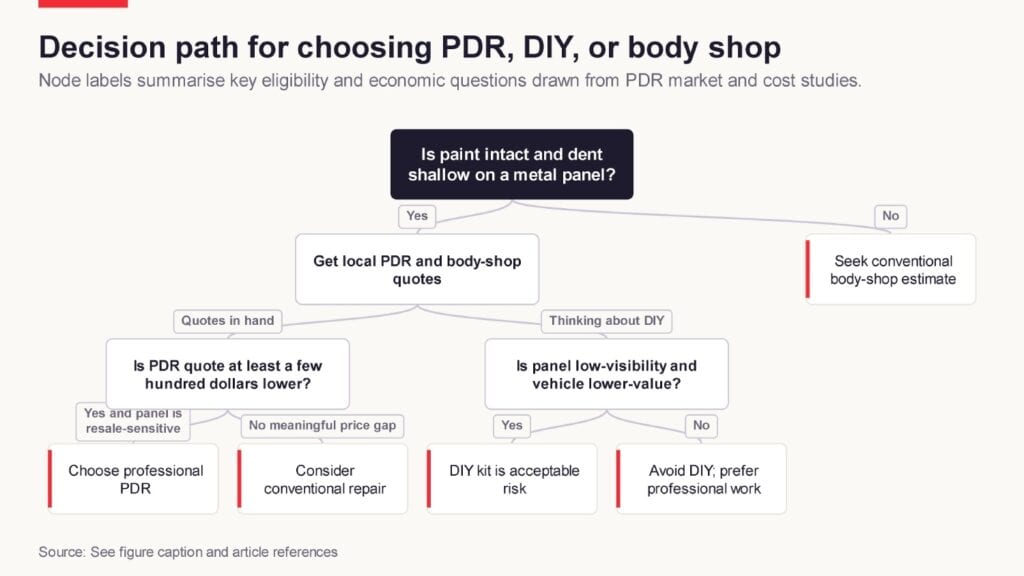
A simplified decision path shows how paint condition, dent severity, access, and vehicle importance jointly determine whether professional PDR, DIY kits, or conventional bodywork is likely to offer the best value. Method: Logic derived from market evidence on PDR eligibility, cost ranges, and kit pricing relative to professional and conventional repair, tailored for consumer decision-making rather than technical diagnosis.
For Houston customers, trust the assessment—not the slogan
PDR pays off when suitable damage, execution, and the actual quote align. Houston drivers and small fleet owners should therefore prioritize vehicle-specific assessments over discount slogans.
Global growth does not establish local service conditions. Growth Market Reports’ 2025 mobile PDR forecast projects expansion through 2033, but supplies no verified Houston prices, appointment availability, or technician density. It also does not demonstrate the performance of Dent Werx or any other individual provider.
A useful local estimate should connect the technical recommendation with the practical commitment. It should identify the covered damage, expected finish, price conditions, and handover time. For mobile work, also confirm workspace requirements and access to the vehicle.
Keeping factory paint and restoring appearance are related but distinct goals. A promise to avoid repainting cannot replace an explanation of achievable finish quality. Likewise, a short repair duration does not guarantee an early appointment.
Small fleets should assess vehicles individually rather than assume every dent warrants identical treatment. Compare repair costs and downtime against each vehicle’s appearance requirements and operational needs. Confirm proposed scheduling efficiencies instead of inferring them from market growth.
For repair businesses, transparent limits make a stronger case than blanket savings promises. Explain eligibility, document the expected result, and acknowledge when conventional bodywork is necessary. The defensible offer is not that PDR always costs less, but that it provides appropriate value for this vehicle.
Limitations
- The evidence consists mainly of summaries of commercial market reports, not independent repair trials. Original report text, underlying datasets, and detailed methods were not supplied for verification.
- Market definitions and estimates differ substantially. Some reported growth rates and savings claims cannot be reconciled with the displayed figures.
- The evidence does not quantify reliable DIY success rates, professional rework costs, resale premiums, or consistent repair-time outcomes.
- Global and North American estimates do not establish Houston pricing, technician availability, or any named provider’s performance. Forecasts through 2030–2034 remain uncertain.
References
- Paintless Dent Repair Market Size, Share & Forecast Report 2025 to …
- Top Companies Analysis
- Global Paintless Dent Repair PDR Service Market Research Report …
- Paintless Dent Repair PDR Service Market: Major Growth …
- Competitor Outlook
- Paintless Dent Repair Service Market Forecast to 2031
- Paintless Dent Repair Service Market by Service Type, Vehicle …
- Paintless dent repair pdr service Worldwide Market Reports
- Automotive Paintless Dent Removal Tools Market – Global Strategic …
- Mobile Paintless Dent Repair Services Market Size & Forecast 2033
- PDR Tools Market Research Report 2033 – Dataintelo
- Automotive Paintless Dent Removal Tools Market 2024-2028
- Paintless Dent Repair Kits Market Research Report 2034