
Paintless Dent Repair in Texas: The Smart Money Guide to Saving Thousandson Hail Damage, Door Dings, and Vehicle Value
A Data-Driven Consumer Guide with Actionable Tips for Every Texas Vehicle Owner
Published April 2026 • All statistics sourced from government reports, industry white papers, and market research
If You Drive in Texas, Hail Is Not a Question of “If” — It’s “When”
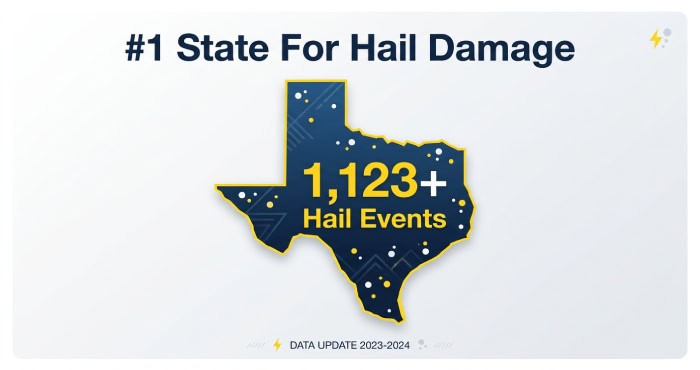
Here is a number that should stop every Texas car owner in their tracks: in 2023, Texas recorded 1,123 separate hail events with stones measuring at least one inch in diameter, more than any other state in the country. Those storms battered roughly two million homes and countless vehicles across the state, according to an official legislative handout presented to the Texas Legislature’s Committee on Insurance.
Let that sink in for a moment: over a thousand hail events in a single year. And the damage these storms leave behind is not minor. In June 2023 alone, storms hammering the Dallas-Fort Worth metroplex caused an estimated $7 billion to $10 billion in insured losses, with a staggering 95% of the damage attributed to hail, according to the same TCAIS/TDI legislative report. This is not a freak occurrence. This is Texas weather, and it’s accelerating.
Meanwhile, the cost of dealing with the aftermath keeps climbing. The average hail-related auto insurance claim in Texas topped $5,700 in 2021, according to the same report. For many Texans, that’s the equivalent of several monthly car payments evaporating because of a twenty-minute storm.
But here’s what most Texas drivers don’t know: there is a repair method that can fix the vast majority of hail dents for a fraction of that cost, in a fraction of the time, while actually protecting your vehicle’s value instead of diminishing it. It’s called paintless dent repair (PDR), and understanding how it works — and when to use it — could save you thousands of dollars over the life of your vehicle.
This guide walks you through exactly what the data says, what it means for your wallet, and what practical steps to take before, during, and after the next Texas hailstorm.
The Numbers Are Getting Worse, Not Better
If you’ve noticed your insurance premiums creeping upward, hail is a major reason. Nationwide, hail claims accounted for 12% of all comprehensive vehicle claims in 2023, nearly doubling from 6.8% in 2022, per the TCAIS/TDI legislative handout. That is not a gradual increase; it is a dramatic year-over-year spike.
What This Means for You
This trend has a direct, measurable impact on your insurance costs. From October 2022 to October 2023, Texas homeowners experienced a greater than 28% average increase in insurance rates — the highest jump in the entire country, more than double the national average of 15.5%, according to the same TCAIS report. Property and casualty insurers in Texas have been operating at a loss, paying out an average of $1.02 for every $1 collected in premiums between 2018 and 2022.
The math is straightforward: more hail events lead to more claims, which lead to higher premiums for everyone. Every claim you file feeds into this cycle. This is where PDR becomes not just a repair option but a financial strategy — because many PDR repairs cost less than your deductible, allowing you to fix your car without ever touching your insurance.
| Every hail claim you file feeds a cycle that raises everyone’s premiums — including yours. PDR lets you step outside that cycle. |
What to Do Next
- Check your comprehensive deductible. If your deductible is $500 or $1,000, minor dent repairs costing $150–$400 through PDR should be paid out of pocket. You get the car fixed, keep your premium stable, and avoid a Carfax entry.
- Budget for PDR preemptively. Set aside $200–$500 specifically for post-storm dent repair. Think of it as weather insurance for your insurance rates.
What Paintless Dent Repair Actually Is — and Why It Works
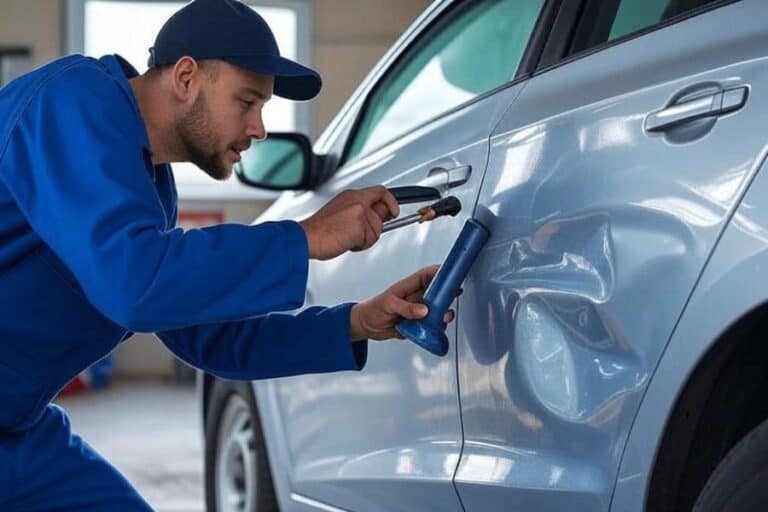
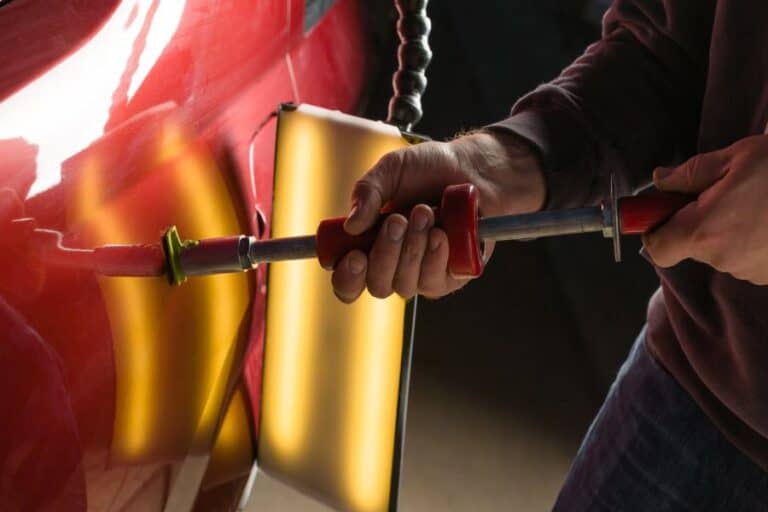
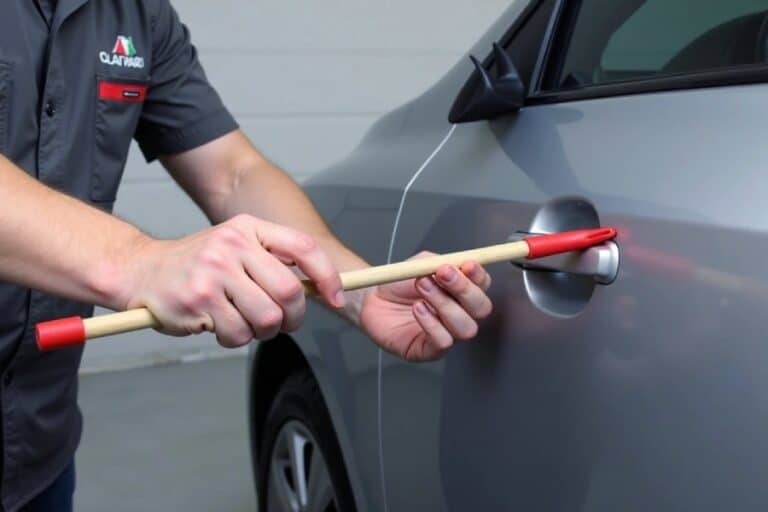
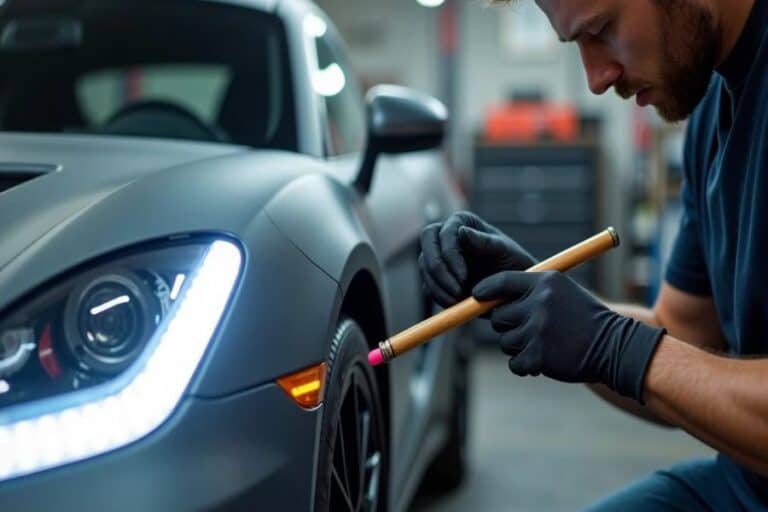
Paintless dent repair is a method where trained technicians use specialized metal rods and tools to carefully massage dented sheet metal back into its original shape from behind the panel. There is no sanding, no body filler, no primer, and no paint. The vehicle’s original factory finish remains completely untouched.
According to AAA, as cited in a white paper published by Mitchell International (one of the insurance industry’s largest claims technology providers), an estimated 80% to 90% of minor dents and dings can be successfully repaired using PDR. That includes the vast majority of door dings from parking lots, shopping cart impacts, minor fender contact, and — critically for Texas — hail damage.
This is not a fringe technique. The global PDR service market was valued at approximately $4.3 billion in 2024 and is growing at a compound annual growth rate of 8%, projected to surpass $6.8 billion by 2030, according to Intent Market Research. The tools market alone was worth $3.35 billion in 2024, per Market Research Future. This is a mature, well-invested industry with established certification standards.
In the United States, the Vale PDR Technician Certification Program sets the professional standard, with approximately 30,000 PDR technicians nationwide requiring certification. Mitchell International provides the diagnostic scanning and calibration technology for the program, which means certified PDR technicians are trained to handle the electronic complexity of modern vehicles, not just the metalwork.
What to Do Next
- Always verify certification. Before hiring a PDR technician, ask whether they hold a Vale certification or equivalent industry credential. This ensures they have been trained on modern vehicle diagnostics, not just basic dent pulling.
- Ask about scanning. Modern vehicles contain sensors behind body panels. A certified technician will perform pre-repair and post-repair diagnostic scans to make sure advanced safety systems are not disrupted.
The Real Cost Comparison: PDR vs. Traditional Body Shop Repair
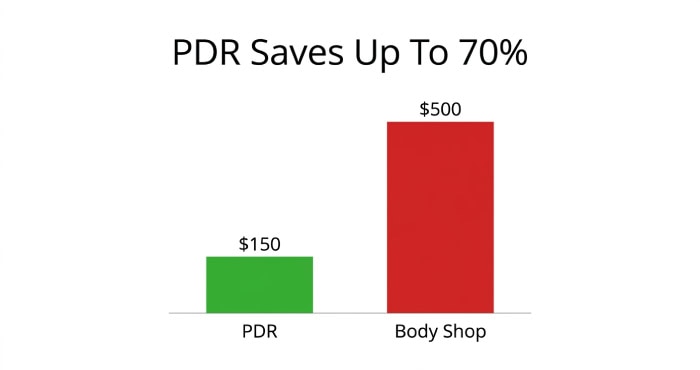
The financial case for PDR over traditional body shop work is not subtle. It is dramatic. According to a detailed cost comparison published by South Bay Collision, PDR typically costs 50–70% less than traditional methods for the same type of minor dent repair.
To put concrete numbers on it: a common door ding repaired with PDR costs around $125. The same repair at a traditional body shop — involving sanding, body filler, primer, paint matching, clear coat, and curing — runs $300 to $500, according to the same source. That is a savings of $175 to $375 on a single dent. Multiply that across a vehicle hit by a hailstorm with fifteen or twenty dents, and the difference becomes thousands of dollars.
The labor economics explain why. A cost analysis by Engineer Fix found that PDR labor costs are 40–60% lower than conventional body shop methods. Traditional repair requires a multi-step process: disassembly, sanding, filling, priming, painting (often requiring blending across adjacent panels to avoid visible color mismatch), clear coating, and reassembly. Each step adds labor hours and material costs. PDR bypasses all of it.
At-a-Glance: What Repairs Actually Cost
| Damage Type | PDR Cost Range | Traditional Body Shop Cost |
| Small door ding (quarter-sized) | $75 – $150 | $300 – $500 |
| Medium dent (up to 3 inches) | $150 – $350 | $500 – $800+ |
| Large dent (5+ inches) | $500+ | $800 – $1,500+ |
| Full hail damage (per panel) | $195 – $2,200 | $1,500 – $5,000+ |
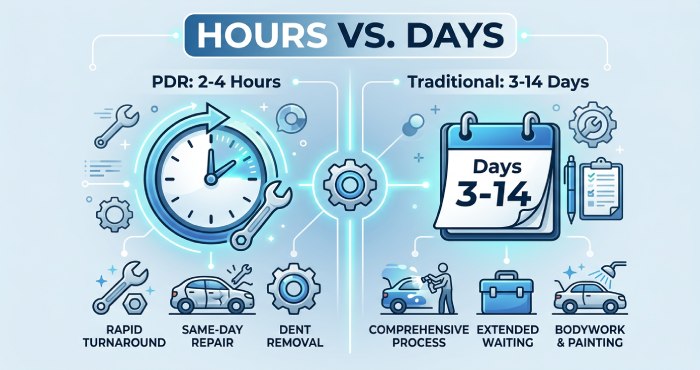
| Typical turnaround time | 2 – 4 hours | 3 – 14+ days |
Sources: National Dent Repair 2024 Cost Guide, South Bay Collision Cost Comparison, Engineer Fix Cost Analysis
The turnaround time difference deserves special attention. When a traditional body shop has your car for a week or more, you are likely paying for a rental vehicle on top of the repair. PDR typically completes most jobs within a single day, often in just a few hours. For dual-income families with one shared vehicle, or for anyone who depends on their car for work, this time savings has real dollar value.
| ⚡ Insider Tip: State Farm’s Actual PDR PricingState Farm publishes an official PDR Pricing Matrix that reveals exactly how they price PDR claims. Key details: pricing is structured by dent count and size per panel, with a 25% markup for double-layered panels, $10 per panel for corrosion protection (capped at $30 per vehicle), and $50 per dent for damage exceeding half-dollar size. If you are filing an insurance claim for PDR, knowing this matrix gives you a baseline for what your insurer should be covering. |
What to Do Next
- Get a PDR estimate first. Before visiting a traditional body shop, get a PDR assessment. Many mobile PDR technicians will come to your home or workplace for a free estimate. You may discover the repair costs less than your insurance deductible.
- Ask about per-dent versus per-panel pricing. PDR shops typically charge per dent or per panel, not a flat rate. Understanding this structure helps you evaluate quotes accurately and avoid overpaying.
- Factor in the rental car you will not need. If your traditional body shop quote is $800 and you’d also spend $250 on a rental car for a week, your true cost is $1,050. Compare that honestly to a $300 PDR repair completed the same afternoon.
The Resale Value Argument: Why Your Factory Paint Is Worth Thousands
For many Texas car owners, the most persuasive reason to choose PDR has nothing to do with the repair itself. It is about what happens after the repair — specifically, when it comes time to sell or trade in the vehicle.
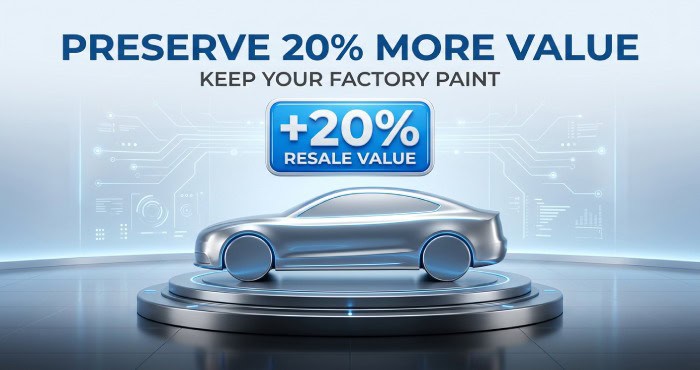
According to data referenced from Carfax and published by National Dent Repair, vehicles with non-original paint or body filler can lose up to 20% more value than those retaining their factory finish. On a $25,000 vehicle, that is a potential $5,000 difference — far more than most PDR repairs would ever cost.
The data from Texas Collision Centers makes this even more concrete for Texans. Their analysis found that professional PDR can increase a vehicle’s value by 10–20% compared to leaving damage unrepaired, and demonstrates a return on investment of 2–3 times the repair cost at the time of resale. Meanwhile, dealers typically reduce trade-in offers by 10–15% for vehicles with visible dents.
The Compounding Cost of Waiting
One of the most overlooked findings in the Texas Collision Centers analysis is about timing. A $200 dent repair left unaddressed can escalate to $2,000 or more as paint begins to chip around the dent, moisture gets underneath, and rust develops. What started as a cosmetic issue becomes a structural one. The repair that once required only a PDR technician now requires sanding, body filler, priming, painting, and blending — exactly the expensive, value-diminishing process PDR was designed to avoid.
| A $200 PDR repair today can prevent a $2,000 body shop bill tomorrow. And it can save you $5,000 at trade-in by keeping your factory paint intact. |
The Carfax Factor
There is another dimension to the resale story that catches many car owners off guard: the vehicle history report. According to industry analysis from Cedar Park PDR specialists, PDR typically does not appear on a Carfax report unless an insurance claim is filed. This matters because Carfax entries — even for minor hail repairs — can reduce buyer confidence and trade-in offers. Paying out of pocket for a $150 PDR repair avoids creating a paper trail that could cost you far more at resale.
Even when PDR does appear on a Carfax report (because an insurance claim was filed for significant hail damage), it is generally categorized under “comprehensive” rather than “collision,” which buyers view less negatively. And because PDR preserves the factory finish, the report effectively tells the next buyer: this vehicle was repaired without repainting.
What to Do Next
- Fix dents before listing or trading in your vehicle. Even if you’ve been living with minor dings for months, a pre-sale PDR session costing $200–$500 can boost your trade-in value by $1,000 or more. It is one of the highest-ROI investments you can make before selling a car.
- For small dings, pay out of pocket. If the PDR cost is under $500, seriously consider paying cash rather than filing a claim. You protect your premiums, your Carfax history, and your resale value simultaneously.
- Mention PDR to buyers. If you have used PDR, tell prospective buyers. The fact that your vehicle retains its original factory paint — verified by a paint depth gauge at any dealership — is a genuine selling point.
The Environmental Angle Most People Miss
PDR’s environmental advantage is significant enough to matter, yet rarely discussed in consumer content. According to a community information sheet published by the U.S. Environmental Protection Agency, traditional auto body shop operations produce emissions of toxic air pollutants, including heavy metals, diisocyanates, and volatile organic compounds (VOCs). The EPA notes that these chemicals react in the atmosphere to form ground-level ozone, which has been linked to respiratory problems.
An academic study from the University at Albany details the specific health impacts: acute exposure to auto refinishing VOCs causes eye, nose, and throat irritation, headaches, nausea, and worsened asthma symptoms. Long-term exposure has been associated with central nervous system damage, liver and kidney harm, and elevated cancer risk.
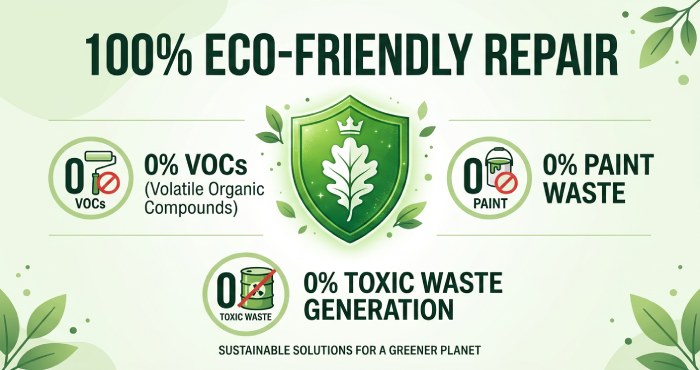
PDR eliminates all of these emissions. No paint is used, no chemicals are sprayed, no hazardous waste is generated. The repair produces no VOCs, no sanding dust containing heavy metals, and no used thinner or solvent requiring special disposal. The only input is skilled labor and steel tools.
This is not a marginal benefit. A 2023 consumer survey found that over 65% of consumers prefer eco-friendly vehicle repair services, according to the WMR PDR Market Report. The same report noted that mobile PDR providers saw a 30% increase in customer satisfaction in 2024, suggesting that the convenience of having a technician come to your driveway — combined with the zero-emission repair process — is resonating with modern consumers.
What to Do Next
- If environmental impact matters to you, ask directly. When requesting a PDR estimate, confirm that the process involves no chemical coatings or hazardous materials. A legitimate PDR shop uses no paint whatsoever.
- Consider mobile PDR for maximum eco-efficiency. A mobile technician drives one vehicle to your location. A traditional body shop requires you to drive to them, potentially shuttle or rent a vehicle, and the shop itself consumes energy for paint booths, ventilation systems, and curing ovens.
Timing Is Everything: A Seasonal Strategy for Texas
If you wait until after the storm to find a PDR technician, you are competing with thousands of other vehicle owners for a limited number of skilled hands. Hail-chasing PDR teams flood into Texas during peak storm season, but so does demand. Wait times increase, quality can vary with fly-by-night operators, and prices can spike.
The data tells you exactly when to prepare. A NOAA/National Weather Service hail analysis for the San Angelo, Texas region found that 94% of very large hail (1.75 inches or larger) occurred during spring months, with peak frequency from late March through June. This pattern holds broadly across central and north-central Texas, including the Dallas-Fort Worth and Austin corridors.
Texas is also home to one of the nation’s largest vehicle populations. The Texas DMV FY 2024 Fact Sheet reports over 94 million motor vehicle records on file in FY 2023. When a major hailstorm hits a metro area, the sheer volume of damaged vehicles overwhelms local repair capacity. Planning ahead is the only reliable way to ensure you get quality service promptly.
| 📅 Your Pre-Storm PDR Checklist (February–March)1. Identify 2–3 certified PDR technicians in your area now. Read reviews, verify certifications, and save their numbers. When a storm hits, you do not want to be searching for the first time.2. Review your insurance policy. Confirm your comprehensive deductible amount and understand what your policy covers for hail damage. Know the threshold at which filing a claim makes financial sense versus paying out of pocket.3. Set aside $300–$500 in a dedicated “dent fund.” If a moderate hailstorm hits, this covers most PDR repairs without touching your insurance.4. Park smart. If covered parking is available at your workplace, gym, or grocery store, use it during storm season even if it means walking farther. The cheapest repair is the one you never need.5. Document your vehicle’s condition. Take dated photos of your car’s exterior in good lighting before storm season. If you do need to file a claim, having pre-storm documentation prevents disputes about pre-existing damage. |
When PDR Is Right — and When It Isn’t
PDR is remarkably effective for the right kind of damage, but it is not a universal solution. Understanding its boundaries will save you time and ensure you choose the right repair path the first time.
PDR Is Ideal For:
- Hail damage where the paint is not cracked or chipped
- Door dings from parking lots, shopping carts, and adjacent car doors
- Minor dents on flat or gently curved panels where the metal has not been stretched
- Body line dents handled by experienced technicians who can restore crisp edges
- Pre-sale cosmetic cleanup to maximize trade-in or private sale value
PDR Is Not Suitable For:
- Dents with cracked, chipped, or peeling paint — these require traditional repair with repainting
- Severely stretched metal where the dent has pulled the panel beyond its elastic limit
- Damage near panel edges or sharp body creases that may require structural work
- Large collision damage involving frame or structural deformation
The 80–90% figure from the Mitchell/AAA white paper refers specifically to minor dents and dings. If a storm has produced paint damage or cracked your clear coat, a traditional body shop may be the right choice for those specific panels, while PDR handles the rest. Many vehicle owners do not realize you can combine both methods on the same vehicle, using PDR where paint is intact and traditional methods only where necessary. A good PDR technician will tell you honestly which dents they can and cannot handle.
The Bottom Line: What the Data Tells Every Texas Driver
The data points in this guide tell a consistent story. Texas has the most hail in the country. Hail claims are accelerating. Insurance costs are rising. And most Texas drivers are overpaying for dent repairs by defaulting to traditional body shop methods when PDR would deliver a superior result at a lower cost — while protecting their vehicle’s factory finish and resale value.
Here is the calculation in its simplest form:
| The PDR Math for a Typical Texas HailstormScenario: Your car sustains 12 small-to-medium hail dents across the hood, roof, and trunk after a spring storm in the DFW area.Traditional body shop estimate: $2,500–$4,000 (sanding, filling, repainting multiple panels, 5–10 days in the shop, plus $200–$500 for a rental car).PDR estimate: $800–$1,400 (no paint, no filler, completed in 1–2 days, no rental car needed).Immediate savings: $1,500–$3,000+Long-term savings: Factory paint preserved, no 20% resale value penalty from repainting, no Carfax collision entry, no insurance premium increase if paid out of pocket. |
The decision is not complicated. For most hail damage and minor dents in Texas, PDR is the better choice by every measure: cost, speed, quality, resale value, and environmental impact. The only step remaining is finding a certified technician and getting your first estimate.
Sources and References
All statistics and claims in this article are sourced from the following documents and publications, listed in order of appearance:
1. Texas Coalition for Affordable Insurance Solutions / Texas Department of Insurance — Legislative Handout to the Committee on Insurance (May 2024). https://capitol.texas.gov/tlodocs/88R/handouts/C4502024091709001/5ebf3ef6-f2b1-4780-ba85-a94e758703a3.PDF
2. Mitchell International / Enlyte — “The Future of Paintless Dent Repair” White Paper (March 2022). https://hub.enlyte.com/m/937ff9de798ea26/original/Mitchell-The-Future-of-Paintless-Dent-Repair-White-Paper.pdf
3. Intent Market Research — Paintless Dent Repair (PDR) Service Market Report (March 2025). https://intentmarketresearch.com/latest-reports/paintless-dent-repair-pdr-service-market-8529
4. Market Research Future (MRFR) — Automotive Paintless Dent Removal Tools Market Report (2025). https://www.marketresearchfuture.com/reports/automotive-paintless-dent-removal-tools-market-30970
5. Mitchell International — Press Release: Vale PDR Technician Certification Program (October 2021). https://www.mitchell.com/insights/news-release/auto-physical-damage/mitchell-named-official-technology-provider-vale
6. South Bay Collision — Paintless Dent Removal vs. Traditional Repair: A Cost Comparison (January 2025). https://southbaycollision.com/2025/01/11/paintless-dent-removal-vs-traditional-repair-cost-comparison/
7. Engineer Fix — How Much Does Paintless Dent Repair Cost? (December 2025). https://engineerfix.com/how-much-does-paintless-dent-repair-cost/
8. State Farm Insurance — Paintless Dent Repair Pricing Matrix (2025). https://role-based-content-app-ui.digital.statefarm.com/b2b/pdr/docs/ss_paintless-dent-repair-matrix.pdf
9. National Dent Repair — 2024 Guide to the Costs of Paintless Dent Repair (December 2024). https://ndrtn.com/2024-guide-to-the-costs-of-paintless-dent-repair-with-average-prices-by-dent-size/
10. National Dent Repair — How Paintless Dent Repair Preserves Your Car’s Resale Value (June 2025). https://ndrtn.com/how-paintless-dent-repair-preserves-your-cars-resale-value/
11. Texas Collision Centers — Dent Repair and Vehicle Resale Value: How Much Does It Matter? (May 2025). https://www.texascollisioncenters.com/post/dent-repair-and-vehicle-resale-value-how-much-does-it-matter
12. Dingz Happen / Cedar Park PDR — Does PDR Show Up on My Carfax Report? (May 2025). https://dingzhappen.com/does-pdr-show-up-on-my-carfax-report/
13. U.S. Environmental Protection Agency — Reducing Air Pollution from Auto Body Shops (2017). https://www.epa.gov/sites/default/files/2017-06/documents/autobody_comm_info.pdf
14. University at Albany, SUNY — The Negative Health Effects and Recommendations for the Auto Refinishing Industry (Honors Thesis). https://scholarsarchive.library.albany.edu/cgi/viewcontent.cgi?article=1001&context=honorscollege_ph
15. WMR / OpenPR — Paintless Dent Repair (PDR) Service Market Set for Rapid Expansion (October 2025). https://www.openpr.com/news/4220424/paintless-dent-repair-pdr-service-market-set-for-rapid
16. NOAA / National Weather Service — Analysis of Historical Hail Size Distribution, San Angelo, TX (2020). https://www.weather.gov/media/sjt/pdf/Hail%20Analysis.pdf
17. Texas Department of Motor Vehicles — Vehicle Titles and Registration FY 2024 Fact Sheet (October 2024). https://www.txdmv.gov/sites/default/files/report-files/FY_2024_VTR_FactSheet.pdf
18. Texas Department of Insurance — Insured Losses Resulting from the February 2021 Texas Winter Weather Event (September 2022). https://www.tdi.texas.gov/reports/documents/feb2021-tx-winter-weather-summary-mar2022.pdf
19. NOAA/NCEI — U.S. Billion-Dollar Weather and Climate Disasters: Events (2024). https://www.ncei.noaa.gov/access/billions/events.pdf
— End of Article —