6 Complications That Can Arise When Multiple Hail Dents Overlap
Overlapping hail dents are more than a cosmetic nuisance. When a hail storm drops dense, fast-moving ice across a hood, roof, trunk lid, or another body panel, the metal can be struck repeatedly in the same area. That clustering changes the repair process, affects damage assessment, and can influence an insurance claim—especially for Houston drivers dealing with severe weather damage across the Greater Houston area.
For broader context on local storm repairs, see Hail Damage Repair Houston. Below are six complications that can arise when multiple hail dents overlap and why professional hail damage repair matters.
Complication #1: Paintless Dent Repair Becomes More Difficult to Perform Cleanly
Why Overlapping Dents Challenge PDR
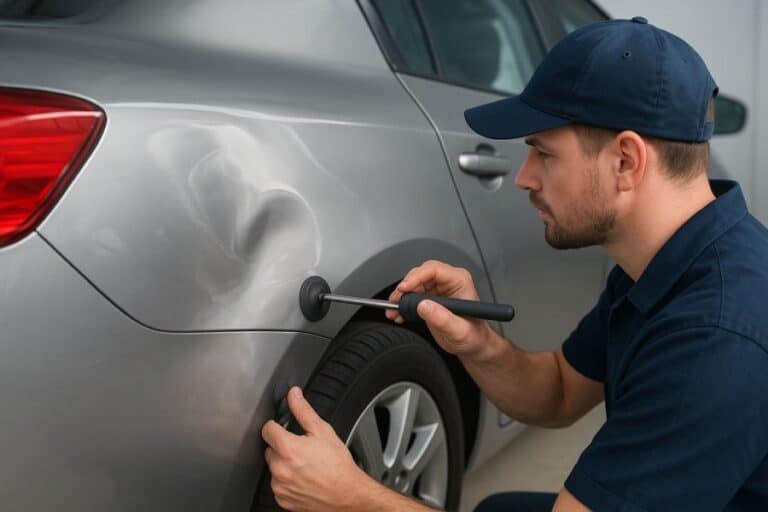
With standard PDR, professional technicians use specialized tools to gently massage the metal back from behind the body panel. This works best when each dent has a clear center, defined edges, and enough surrounding metal to stabilize the repair. When several hail impacts overlap, the technician may be working with a distorted field rather than one clean dent.
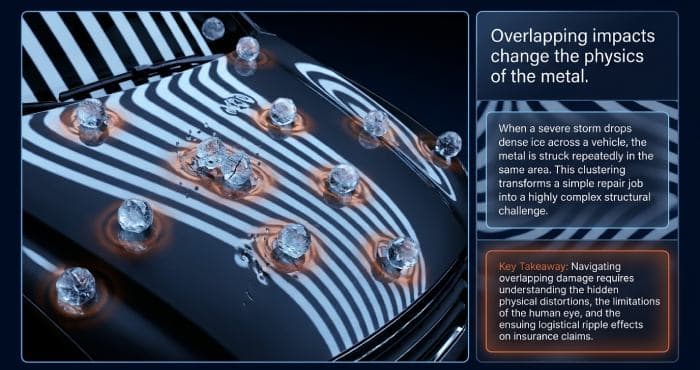
That makes dent repair more complex because pushing one low spot can create movement in another. A technician may correct one depression only to reveal hidden micro-dents, tight crowns, or tension lines nearby.
Clean Access Matters
PDR often depends on access points behind the body panel. In car dent repair, hoods and trunk lids may be easier to access than roof rails, pillars, or braced panels. When dents cluster near reinforcement structures, auto hail damage repair may take longer and require state-of-the-art equipment, advanced lighting, and careful tool selection.
When PDR May Still Be the Best Option
Even with overlapping damage, PDR (Paintless Dent Repair) is often the preferred option if the original paint is intact. Compared with a collision shop repair involving body filler and refinishing, paintless dent repair can better protect vehicle value, support a fast turnaround, and maintain the factory finish.
Complication #2: Stretched Metal Can Create Waves, Ripples, or High Spots
Metal Memory Has Limits
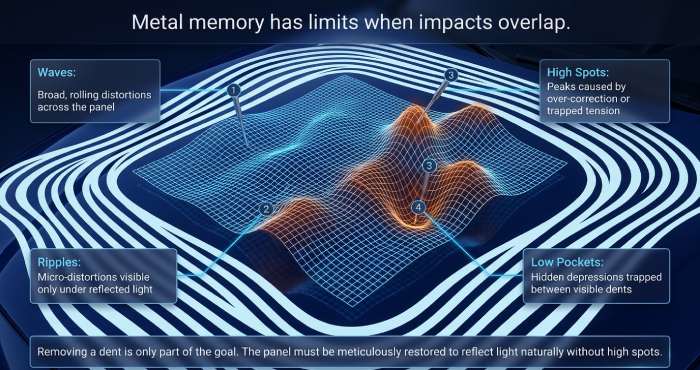
Technicians often talk about “metal memory”—the tendency of a panel to return to its original shape when pressure is applied correctly. PDR uses this principle. When hail impacts occur close together, the panel can develop complex distortions, including stretched areas, crowns, and high spots. These conditions require careful assessment to determine the appropriate repair approach.
This can create:
- Waves across the panel
- Ripples under reflected light
- High spots from over-corrected areas
- Low pockets hidden between dents
- Distortion near body-line dents
Why High Spots Are a Problem
High spots can be as noticeable as dents, especially on dark paint or vehicles with ceramic coating, fresh detailing, or high-gloss finishes. In professional dent repair, removing a dent is only part of the goal. The panel must also reflect light naturally.
Experienced PDR technicians use controlled pressure, specialized tapping tools, and reflection boards to identify and correct panel distortion accurately.
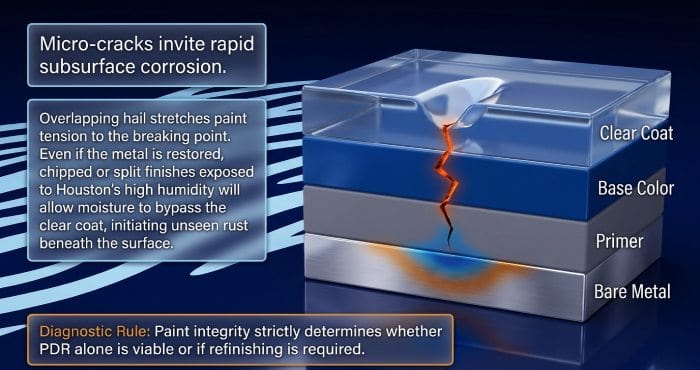
Complication #3: Cracked Paint or Clear Coat Increases the Risk of Rust in Houston’s Humid Climate
Paint Integrity Determines Repair Options
Paintless Dent Repair works best when the paint remains flexible and unbroken. If the finish is cracked, chipped, or split, a technician must evaluate whether PDR alone is appropriate or whether additional refinishing is needed.
Rust Can Spread Beneath the Surface
When hail impacts chip or crack the paint enough to expose the underlying metal, moisture can contribute to corrosion over time. A professional inspection can help determine whether refinishing is necessary.
Professional technicians will inspect the finish closely before recommending hail damage repair, door ding repair, crease repair, or a combination of services.
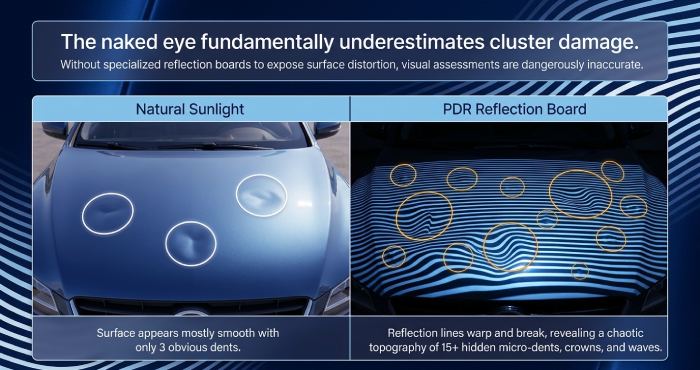
Complication #4: Damage Assessment Becomes Less Accurate Without Professional Lighting and Inspection
Why Lighting Changes Everything
PDR lighting exposes distortion in the reflection across the body panel. It helps technicians see dent depth, impact direction, crowns, ridges, and hidden waves.
Without professional lighting, a damage assessment may underestimate:
- Dent count
- Dent size
- Paint cracking
- Panel distortion
- Access difficulty
- Repair time
The Value of a Free Evaluation
A free evaluation or free estimate allows technicians to map the full scope of the repair process. Many reputable Texas dent repair providers offer a quick quote, but overlapping dents often require an in-person inspection for accurate estimates.
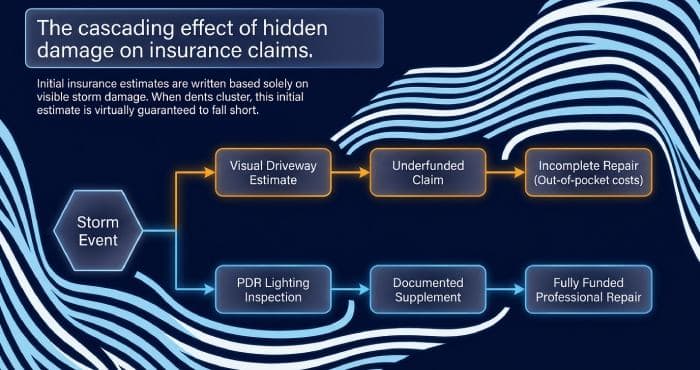
Complication #5: Insurance Claims May Be More Complicated When Dents Cluster Together
Insurance Carriers May Estimate Differently
The insurance carrier may write an initial estimate based on visible storm damage, but that estimate may need to be supplemented after a professional inspection.
This is common in hail damage repair because hidden dents become more visible once the vehicle is cleaned, placed under lights, and reviewed by trained technicians.
Documentation Helps Protect the Claim
A strong insurance claim typically includes:
- Clear photos under proper lighting
- Full panel-by-panel damage assessment
- Dent counts by body panel
- Notes on cracked paint or stretched metal
- PDR feasibility
- Any need for panel restoration or refinishing
A professional hail damage repair team can document the visible damage, explain available repair options, and help vehicle owners understand the information needed for an insurance supplement.
Complication #6: Repair Costs and Turnaround Times Can Increase for Houston Drivers
Why Overlapping Damage Takes Longer
Each body panel must be evaluated individually. A hood with widespread overlapping dents may need several hours of PDR, while a roof with bracing underneath may require additional access planning. If body-line dents are involved, repair complexity increases further.
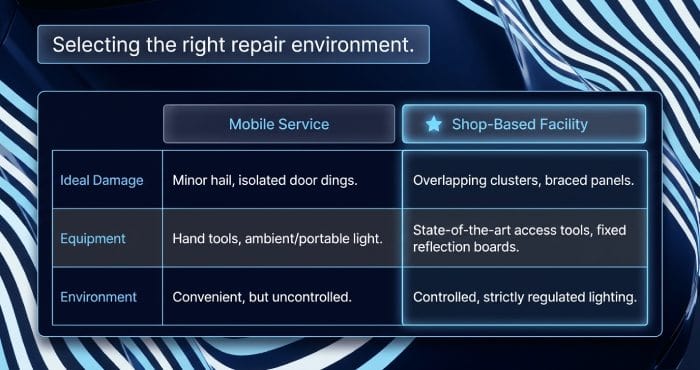
Mobile Service vs. Shop-Based Repair
Mobile dent repair is excellent for many types of dent repair, including door dings, minor hail damage repair, and small car dent repair jobs. A mobile service can provide a convenient process at a home or workplace.
However, extensive hail damage repair with overlapping dents may be better handled in a controlled facility with state-of-the-art equipment. A collision shop may be needed if the original paint is compromised, while PDR specialists may be best when the factory finish is intact.
Cost Factors Houston Drivers Should Expect
Repair pricing may depend on:
- Number of dents per body panel
- Dent size and depth
- Access behind the panel
- Paint condition
- Need for crease repair
- Need for door ding repair or body-line repair
- Whether mobile dent repair is appropriate
- Whether insurance supplements are required
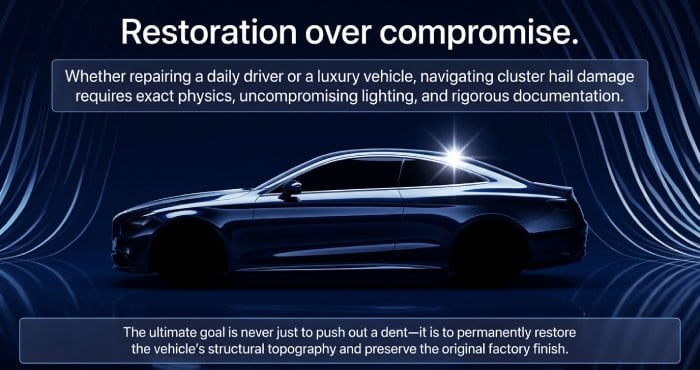
Experienced PDR technicians explain the available repair options and help vehicle owners choose the most suitable solution for their hail damage. Whether it’s a classic car, luxury vehicle, or daily driver, the goal is to restore the vehicle’s appearance, preserve its original factory paint whenever possible, and deliver quality, cost-effective repairs.